For Prime Minister Stephen Harper, there is no better way to practice fiscal restraint than to spend $50,000 on repainting the old jet. This raises three questions: Do we really need to repaint it now? When did blue become one of Canada's official colors? What happened to fiscal restraint? Stephen Harper plans to repaint his grey Polaris CC-150 military jet to red, white and blue. Although, while officials at the Prime Minister's Office insisted the repainting would be cost-neutral for more than two years, the Huffington Post has learned that the stencil used to paint the plane has driven up the cost.
The new look was designed by Royal Canadian Airforce graphic designer Jim Belliveau.
In comparison to how it looks today:
Harper's office said that as long as the project were cost-neutral, the repainting could be added into the regular maintenance schedule of the plane.
“As we have consistently said, any change would only be contemplated if it were cost neutral, and performed as part of DND's regular maintenance cycle,” Harper’s spokesman Andrew MacDougall told HuffPost last summer.
But now, with the price tag, a senior official who spoke to HuffPost on the condition of anonymity has defended the necessity of the paint job stating the cost is modest and only represents 2% of the plane's total maintenance cost. and that “This decision is consistent with past Canadian practices and will better promote Canada’s image at home and abroad.”
The federal government also believes it will save $3.2 million annually by retiring four of the six challenger jets used by the Prime Minister and top officials.
“Our Government has reduced average annual spending on ministers' use of challenger flights by over 80% compared to the previous Liberal government,” the official said.
However $50,000 is $50,000 and in times of fiscal restraint, every nickel should be accounted for and used properly. There are more important places to invest $50,000 than painting an airplane for the Prime Minister and his top military officials. Additionally, it appears the reason for painting the plane is arbitrary. It is ironic that Canada's flag and official colors are red and white but the plane will include an additional color: blue. Interestingly, the color blue is the Conservative's branding and has become much more apparent since they took power in 2006.
What do you think of the planned expense of $50,000 to repaint the challenger jets? Join us and let us know what you think: Facebook, Twitter, Google+.
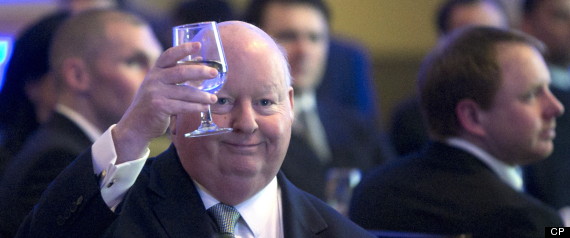
It turns out that Conservative Senator Mike Duffy is out of breath running away from the media. With the controversy over his housing allowance gaining ever more spin, and a senate spending audit underway, Duffty decided he would pay back the funds he received admitting they were not entitled to him and he also claimed the situation to be a misunderstanding. Based on Duffy's actions, it may be well worth questioning the authenticity of this action. How can we possibly forget the huge commotion over housing allowance? When news broke that Conservative senators were cashing in on monies that weren't entitled to them, Canadians wanted answers and so did the media. Mike Duffy, a former reporter for CTV, received $33,000 for his housing allowance and it turns out he wasn't entitled to it. Rather than confront the questions about the legitimacy of his eligibility to the program in an honest and sincere manner, like any innocent person would, we recall him bursting out the back of a kitchen hollering at journalists when they confronted him on this issue. First off, if Duffy wasn't a senator, he would have been one of those journalists so he knew what to expect and second, running through a kitchen to dodge questions - does that not raise a red flag about his conscience?
"The Senate rules on housing allowances aren't clear, and the forms are confusing," Duffy said in a statement late Friday. "I filled out the Senate forms in good faith and believed I was in compliance with the rules. Now it turns out I may have been mistaken."
In the meantime, senators Duffy, Pamela Wallin, Mac Harb, and Patrick Brazeau all face an audit into the legitimacy of their housing allowance claims.
The necessity of Duffy's housing allowance claims in particular came about when it had been discovered that his documented primary residence in Prince Edward Island was being overshadowed by another primary residence in Ottawa. The constitution requires senators to live in the provinces they were appointed to. It also came about when public figures in PEI stated that he was ineligible for permanent resident status in the province.
"Rather than let this issue drag on," Duffy said, "my wife and I have decided that the allowance associated with my house in Ottawa will be repaid."
Meanwhile, NDP Ethics Critic Charlie Angus charges that repaying the allowance shouldn't be the end of the story.
"How could it be that you can fill out forms to collect money you're not entitled to and then you have to get caught, you have to get hounded to pay it back, and then you can just shrug and say, 'Catch me the next time.' That's not good enough," Angus said.
"If an ordinary citizen did that, they'd be in jail."
In the meantime, as Angus noted, the federal government is sending federal agents to check on EI recipients.
"If it's good enough to go after EI claimants, if it's good enough go after tax cheats, then they should be going after Senate cheats," he said, adding that the police should be called in.
But while Duffy claims that the whole situation was a misunderstanding, Angus argues that the circumstances are clear enough as they stand.
"Mr. Duffy lives in Kanata. He's claiming a housing allowance that is intended for senators who actually live in the province they represent. I don't know how much clearer you could be," Angus said.
Duffy's decision to pay back Canadian taxpayers may have been the right move, but a few weeks earlier, he dodged the issue altogether by running out of a kitchen in Halifax, telling reporters that there are better things to report about like energy. In the meantime, the senate is about to audit the suspicious claims and this is the time when Duffy backs out. Is there any more expenditure to hide? Did it really have to take Duffy the fact that he got caught to do the right thing? Or was it that he would rather dodge the audit to avoid any future scrutiny on any other spending ventures that he's been up to?
We can applaud Duffy for paying back the $33,000 he owes us, but given the circumstances in which we got it back, it should make us wonder what would have happened without the commotion and forced audit and if mandatory periodic audits of all senators should be one of those reforms Harper spoke of six years ago when he said he wouldn't appoint his cronies to the senate. What do you think of Duffy and his situation, is his repayment a sincere mistake or a surrender to being caught? Would mandatory audits be something that can keep other senators in line and responsible with taxpayers' money? Join us and let us know what you think: Facebook, Twitter, Google+.
What started as a $90,172 claim of inappropriate expenses seen as an outrage as part of abusive senate behaviour quickly escalated to a scandal with many more questions than answers. Get up to date with the full timeline. Read more
Stephen Harper's recent defense of Senator Pamela Wallin's travelling expenses in times of austerity should have raised a red flag. Add on top of that, Senator Bert Brown's claim that asking for his traveling expenses is a "threat" and what we already know of Senators Mike Duffy and Patrick Brazeau and only one thing can be said: for Conservatives, it's alright for senators to be loose with taxpayer money. Between March 1, 2011 and February 29, 2012, taxpayers received a $142,490.26 bill for Pamela Wallin's traveling expenses. Of this, $10,511.99 was documented as travel and the remaining $131,638.27 was billed as other.
Prime Minister Stephen Harper said her expenses were reasonable as they were comparable with the expenses of a travelling MP.
"Her travel costs are comparable to any parliamentarian travelling from that particular area of the country over that period of time," he said.
"Last year, Sen. Wallin spent almost half of her time in the province she represents in the Senate. The costs are obviously to travel to and from that province, as any similar parliamentarian would do."
Meanwhile, as Senators' spending comes further under scrutiny, audits are being performed and elected Alberta Senator Bert Brown has claimed that asking for his his traveling expenses is a "threat". Bert is among Canada's top 5 spending senators and when Global News asked him about releasing his financial information, he responded:
“If you go and do the work you can find everything that every Senator has done... If you are going to threaten people, you need to find out what’s true and what’s not, so do the work.”
Brown was appointed in 2007 and has since racked up $316,000 in traveling expenses including $298,500 to Alberta and $17,500 elsewhere.
The Conservatives were the ones who campaigned on a platform of accountability and if they were serious, this would apply to the senate as much as it would have the House of Commons. Incidentally the Conservatives are also the ones who usually criticize entitlements.
This brings us to the topic that made headlines for weeks: Housing Allowance. When it came to getting the facts, neither Patrick Brazeau or Mike Duffy wanted to answer questions. In fact, Duffy took the extra effort to run out of a kitchen while telling journalists, "You should be doing adult work. Write about energy," when they confronted his mismatched address. Meanwhile, Brazeau has been removed from the senate, not because no one in his Kitigan Zibi First Nation community ever saw him live there, despite his claims for the aboriginal income tax exemption, but because of allegations of Domestic and Sexual Assault that will soon be going to court.
The controversy starts with senators who claim to live far away from Ottawa, and then reality checks pointing to them living near Ottawa.
Senators can claim up to $21,000 in housing and meal expenses annually if they can prove that they live at least 100km away from the Ottawa region. Both Duffy and Brazeau have failed to do such but despite this, they will continue to receive these payments and not be forced to reimburse taxpayers - or be fired for fraud.
Senator Patrick Brazeau's home in Gatineau, Quebec
Brazeau lives in a nice house in Gatineau, Quebec, despite claiming both the Housing Allowance and an Aboriginal Income Tax Exemption. Duffy lives in Ottawa, despite making the false claim that he lived in Prince Edward Island where public reports state that he doesn't qualify for the permanent residency that has got him the lower tax rates in the province.
However, one thing stands clear from all of this, if the Conservatives actually cared about fiscal prudence and accountability, none of this would have happened. It stands to reason then that for the Conservatives, it's alright for Senators to be loose with taxpayer money. Do you agree? Join us and let us know what you think: Facebook, Twitter, Google+.
What started as a $90,172 claim of inappropriate expenses seen as an outrage as part of abusive senate behaviour quickly escalated to a scandal with many more questions than answers. Get up to date with the full timeline. Read more
International Cooperation Minister Julian Fantino is defending $544,813 in federal funding that went to Ontario-based evangelical group Crossroads Christian Communications that describes homosexuality as a perversion and a sin. The group produces television programs and received the money to dig wells, build latrines and promote hygiene awareness in Uganda until 2014.
Fantino tried to cover those tracks by stating that the The Canadian International Development Agency, an agency he adopted after former CIDA minister Bev Oda resigned over a slew of controversy, is responsible for providing funds to organizations working on foreign aid projects and that their religious and political views are irrelevant.
"We fund results-based projects, not organizations," Fantino said. "Projects are delivered without religious content, including this particular project."
A spokeswoman for Fantino added: "The government of Canada has funded projects by this organization since 1999."
Meanwhile, NDP MP Helene Laverdiere said CIDA's funding initiatives are "out of step with Canadians."
"How did Christian Crossroads, an anti-gay organization, get sign-off from the minister to operate in a country which Canada has strongly criticized for persecution of its gay citizens?"
So the question here is: Should an organization's political views determine whether it should get funding? The Conservatives say no, the NDP say yes. Let's take a look at the political situation in Uganda.
The government in Uganda plans to pass a bill that will execute homosexuals and possibly give them the death penalty. Crossroads recently listed homosexuality as a sin.
Stephen Harper once debated same-sex marriage, defining marriage as the "union of one man and one woman" at an anti-gay rally at Parliament Hill in 2005.
Laverdiere stated that the Conservatives have been selective over funding and while groups it doesn't like were cut off, "religious groups that promote their ideology have Conservative connections."
"This is absolutely bogus," Fantino retorted. "Religion has nothing to do with any of that."
NDP Leader Thomas Mulcair attacked Fantino on the grounds that he was defending a group that breaks Canadian laws.
"It's shocking to hear Minister Fantino defending the indefensible, standing up today and defending a group that on its website is attacking something that's recognized and protected by Canadian law."
Laverdiere isn't the only person to express this view, Francois Audet from the Canadian Research Institute on Humanitarian Crisis and Aid said, "I have the clear impression — and I am not the only one in the scientific community — that behind this, there is a deliberate strategy to finance the groups ideologically close to the actual Conservative government."
So is this all a political scheme set by the Conservatives to institutionalize and promote their ideology or is their defense that religion has nothing to do with it valid? Note that in this case, it is questionable how much help an anti-gay organization can be in a country where people are going to be persecuted and put to death for being gay.Follow us and let us know what you think: Facebook, Twitter, Google+.
Accountability and transparency were the hallmarks of Stephen Harper's win in 2006 but despite robotic scripts that claim accountability is the utmost priority, recent report cards and trends show that accountability and transparency have been thrown out the window. Information Commissioner Suzanne Legault says the Harper Government is "not the most transparent" and that Access to Information requests have been responded to at all time lows.
"We are at a record low in terms of timeliness," Legault told CBC Radio's Sunday Edition. "The percentage of information being disclosed is also low."
She has been in office for three years and her office has taken an 8% budget cut and has to deal with 2,000 complaints after having dealt with 7,000. While the government is reluctant to answer to Access to Information requests, they are kicking the cans down the road at a record pace.
"In the recent statistics provided by the government, requests for extensions [by departments] are at a record high."
Access to Information requests demand a response within 30 days, but departments can ask for extensions. One extension request, made by the Ministry of Defense, asked for 1,110 days and is now before Federal Courts.
"I don't have order-making power. I only have recommendation power," Legault noted.
Furthermore, the bad news for the Conservative record is after making promises to improve transparency and accountability, we're told the last time Canada's legislation was updated was in the 1980s.
"Generally, countries which have amended their legislation since 2000 include more modern elements ... the U.K. and Australia have given their commissioners order-maker power," said Legault.
A report made by Legault last year gave the Canadian Food Inspection Agency, the department of Northern and Indian Affairs, and Transport Canada "F" grades for their timeliness at responding to Access to Information Requests. When it came to disclosure, the department of defense hit the bottom.
"It prevents Canadians from holding governments to account — especially in the way they respond to crises."
"Canadians should be angry," she said. "It's really a fundamental democratic right in Canada [and] it's linked to freedom of expression."
Meanwhile, Canada's reputation with this regard is taking a hit on the world stage. A Reporters Without Borders report ranked countries on its media freedom.
In the latest report, Canada took a 10 point hit over the previous report leaving Canada in 20th place. The top three countries are: Finland, the Netherlands and Norway.
The report noted that Canada lost "its status as the western hemisphere's leader to Jamaica (No. 13). This was due to obstruction of journalists during the so-called 'Maple Spring' student protests and to continuing threats to the confidentiality of journalists' sources and internet users' personal data, in particular, from the C-30 bill on cyber-crime."
Legault said she would like Canada to once again become the envy of the world but that it will need a strong jolt to do so.
"We need more voices to weigh in. It's a very important right and we must fight for it."
It turns out that the government Canadians elected on the basis of trust and accountability can't be held to account and can't be trusted. We have a government that runs from the media and muzzles those with something worthy to say. We have a government that is fixated over control and is ready and willing to restrict people's freedom to maintain it. This report about Harper's record of transparency doesn't reveal anything groundbreaking, it just makes a trend Canadians have seen for a while official.
When a government has lost its sense of accountability and principle, it has lost its moral authority to govern. The promise of accountability was a lie, and as a consequence, we now have the most secretive and restrictive government in history. Do you still trust this government? Follow us and let us know what you think: Facebook, Twitter, Google+.
Canada's justice system has allowed criminals to use mental illness as a way to dodge justice. The Conservative government introduced a new "high risk" label for people found not criminally responsible for a crime they've committed. While this modification to the Criminal Code is a step in the right direction, it would also be beneficial to enact and focus on crime prevention before these people enter the system. "If you do the crime, prepare to do the time" has been the Conservative mantra on crime for years and while it brings some sense of justice to victims, it doesn't prevent future cases and victimization from happening. Albeit, under Canada's laws, some criminals have managed to use the mentally-ill card to try to dodge justice.
In one case, a former Quebec cardiologist was let back onto the streets after being detained for 18 months for being found not criminally responsible for killing his two children in 2009 because his wife left him. Nothing can bring back the lives of those innocent young children, why should he be rewarded with his freedom? Furthermore, what guarantee does society have that this man isn't going to kill another person for another reason and then be tried as "not criminally responsible."
Another such example of a case that defies logic is the beheading of Tim McLean on a Greyhound bus in Manitoba in July 2008. The Manitoba review board ruled that Vince Li would be allowed to make supervised visits to the community last May. After beheading and cannibalizing an innocent man, why should Li be allowed back into society? What message does this send to McLean's family? That the justice system values Li's freedom more than the fact that he took their beloved's life?
McLean's mother Carol de Delley is pleased with the legislation, stating she was skeptical things were ever going to change.
"I'm very pleased that this has come about as quickly as it has," de Delley said.
"I've honestly felt, like everybody else, with government it's going to take forever and a day for anything to change."
The new legislation is set to give the courts the power to lock up people who are found not criminally responsible for their crimes if they are deemed to be a "high risk" threat.
Prime Minister Stephen Harper announced that the new legislation would enable authorities to put public safety first.
"This will ensure that 'not-criminally-responsible' accused people found to be too dangerous to be released are no longer a threat to their victims or Canadian communities."
People found "not criminally responsible" and "high risk" would get evaluated every 3 years rather than every year to determine if they are fit for release. The person's release would require a court to agree and the government said they "could only obtain an escorted pass in narrow circumstances," but otherwise would never receive an unescorted pass. If the court grants release, the victim's family will be notified of the release.
"We've heard from Canadians loud and clear, something here is very wrong," Harper said Friday.
The current system has a board that assesses such cases and creates a plan "that both protects the public and attempts to provide opportunities to treat the underlying mental disorder."
The new system, Harper said, "would explicitly make public safety the paramount consideration in the court and the review board decision-making process." This is a step in the right direction for the victims who have lost parts of their lives because of these crimes and prevents future crimes from taking place by keeping "high risk" candidates off the streets.
The plan will also redefine what a security threat is to actions that are "criminal in nature but not necessarily violent in order for restrictions to be imposed on an accused."
The existing definition of treatment said that the courts would choose "the least onerous and least restrictive" conditions for the accused.
In essence, what the Conservatives are doing is taking a system that is based on finding an equilibrium between public safety and the rights of the accused and tilting it more towards public safety. In a system where a man is able to come out of a mental ward 18 months after being committed for killing his two children, there is no doubt that the "balanced approach" is either broken or simply ineffective.
While the tilt towards public safety will prevent repeat offenses, there is nothing in this legislation towards improving services geared toward treating the mentally ill before they enter the criminal system. By investing in programs and clinics that give the mentally ill the treatment they need, the government can save the justice system the burdens down the road and potentially prevent future victims from facing the crimes that lead up to this state. Nonetheless, these preventative actions can be presented in future Bills or as amendments so as the legislation stands, in principle, it is a step in the right direction.
What do you think of the new legislation? Do you think it is a step in the right direction? Follow us and let us know what you think: Facebook, Twitter, Google+.
The senate is supposed to be a chamber of sober thought. Once the partisan House of Commons has finished getting legislation passed, the Senate is to revise it and amend it where necessary. In recent years, however, the senate has become as much a political obstacle as the House and not without its fair share of grievances Canadians can fire a corrupt parliamentarian but getting rid of a corrupt senator is a much harder task.
Once you've been appointed to the senate, you can stay there until you are forced to retire at the age of 75. Once you've been appointed to the senate, you can rest assured that regardless how much controversy dogs you down, you will keep that senate seat. Once you've been appointed to the senate, you'll get a 69 day working year along with an annual salary of $132,000, a slew of perks and a cushy retirement.
However, under some circumstances, a senator can be fired. Under the Constitution, failing to give an Attendance or betrays the country or going bankrupt are some of those options but corruption, theft, and fraud are not sufficient cause to fire a senator, unless the courts hand down a jail sentence.
Under the Constitution, the conditions required for a senator to be fired are as follows:
If for two consecutive Sessions of the Parliament he fails to give his Attendance in the Senate;
If he takes an Oath or makes a Declaration or Acknowledgment of Allegiance, Obedience, or Adherence to a Foreign Power, or does an Act whereby he becomes a Subject or Citizen, or entitled to the Rights or Privileges of a Subject or Citizen, of a Foreign Power
If he is adjudged Bankrupt or Insolvent, or applies for the Benefit of any Law relating to Insolvent Debtors, or becomes a public Defaulter;
If he is attainted of Treason or convicted of Felony or of any infamous Crime;
If he ceases to be qualified in respect of Property or of Residence; provided, that a Senator shall not be deemed to have ceased to be qualified in respect of Residence by reason only of his residing at the Seat of the Government of Canada while holding an Office under that Government requiring his Presence there.
This means that despite the controversies over Housing Allowance, both Senators Patrick Brazeau and Conservative Mike Duffy will not be held to account for defrauding Canadian taxpayers. It also means that charges of domestic and sexual assault are only enough to get Brazeau kicked out of the Conservative caucus, but as long as he isn't found guilty, he can still keep the seat, the salary, and all of the other perks that Canadians are collectively paying for. During a court period, the most that would happen to Brazeau is a forced leave and a loss of benefits over the time frame.
The last time a senator met the conditions to be fired, he got to keep his pension by resigning. Former Liberal Senator Raymond Lavigne was found guilty of fraud and breach of trust for making false travel claims worth $10,000 and for using an office staffer to cut trees at his cottage.
Former Liberal Senator Andrew Thompson was held in contempt of the senate after showing up for only 2 weeks in over 7 years of his mandate. Thompson was stripped of the salary but resigned and got to keep his pension.
If Brazeau isn't found guilty in court hearings surrounding assault charges, he can stick around for another 37 years and despite his fraudulent claims of senate perks, he can rack up over $5 million by the time he retires.
Both Brazeau and Duffy have a lot of explaining to do when it comes to housing allowance. While former CTV reporter and newly minted Conservative senator Duffy dodged questions by running out a hotel kitchen's door in Halifax, Brazeau's false paper trail is stacking up by the day.
As Duffy ran from reporters who questioned his $33,000 housing allowance since 2010 for claiming that his cottage house in Prince Edward Island was his primary residence while he was spending most of his time in his Ottawa house, he told them "You should be doing adult work. Write about energy." Public reports state that Duffy doesn't qualify for the permanent residency that has got him the lower tax rates in the province.
Brazeau, meanwhile, has used his former father-in-law's address in an aboriginal community to get an aboriginal income tax exemption from 2004 to 2008.
Residents of the Kitigan Zibi First Nation community said he doesn't live there.
“I’ve never seen him,” resident Jean Guy Whiteduck said. “It’s right across from my place. I’ve never seen him there. He may have visited. That’s about it.”
Senators can claim up to $21,000 in housing and meal expenses annually if they can prove that they live at least 100km away from the Ottawa region. Both Duffy and Brazeau have failed to do such but despite this, they will continue to receive these payments and not be forced to reimburse taxpayers - or be fired for fraud.
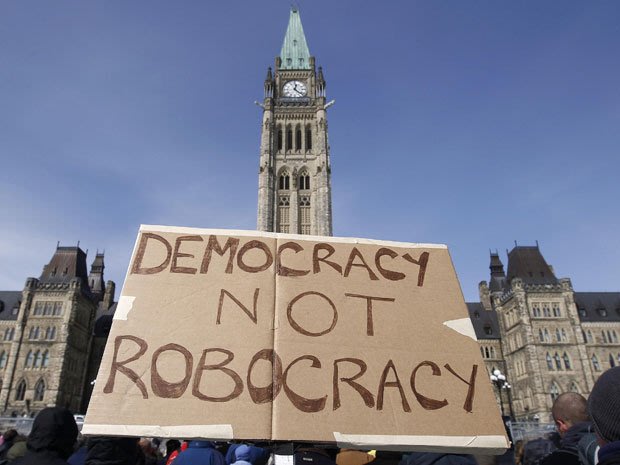
Last Friday, Saskatchewan residents received an automated message criticizing the province's new federal riding boundaries. The calls weren't identified and the Conservatives denied involvement until Tuesday when communications director Fred DeLorey released a statement blaming "internal miscommunication" for the slip up. Meanwhile, it appears that what seemed to be an isolated occurrence of a robocall is linked to the massive campaign that happened in 2011. When news broke of a targeted robocall campaign that was intent on misleading selected Canadians into polling locations, the irregularities started popping up all across Canada. With many pieces of the puzzle linking to the ruling Conservative party, Canadians became evermore cynical of the way politics is conducted and began their calls for a public inquiry.
Arguably, the 'tough on crime' Conservatives should have pursued the suspicion of crime, voter suppression to be exact, but instead they started to point fingers and downplayed the misleading robocalls which served to be a major offense against Canadian democracy.
The recent robocalls in Saskatchewan uncover some interesting observations:
While the Conservatives initially denied involvement, they admitted to it a few days later. Here is what DeLorey had to say:
Last Friday:
"We are not polling."
Tuesday:
"In regards to the calls last week that went into Saskatchewan concerning redistribution, the calls came from the Conservative Party.
There was an internal miscommunication on the matter, and the calls should have been identified as coming from the Conservative Party.
As I said in the past, we are not polling on this issue, we already know where people stand - 75% of people who attended the public hearings and submitted written submissions opposed these drastic changes to the boundaries.
But we are doing a host of things to communicate with voters and get their feedback.
Not only were these changes opposed by 75% of the public, but an actual member of the commission also opposed these changes, which led to an unprecedented Dissenting Report by the boundary commission."
The calls were meant to criticize the new electoral map that was drawn by a non-partisan institution. Note that with Canada's first-past-the-post system, the size of the riding can and will change the outcome of who wins the seat and down the line, who forms the government. This sparked debate in the House of Commons between NDP leader Thomas Mulcair and Conservative Prime Minister Stephen Harper.
Thomas Mulcair: "The independence of the Canadian electoral boundary commission is fundamental to our democracy. Conservatives paid for fraudulent robocalls using a fake company name to misinform voters and manipulate an important part of our democratic system.
Worst yet, Conservative party officials lied to Canadians to try to avoid taking responsibility for their actions. Who will the prinme minister hold accountable for this fraud?"
Stephen Harper: "Clearly I rejected the accusations of that particular question. I think the party has explained this particular matter. As I think the Speaker knows very well, there are electoral commissions in effect to redraw boundaries. Those commissions accept and expect input from Parliamentarians, from political parties and from the general public. There has been, in Saskatchewan, overwhelming opposition to the particular proposals but we are simply operating within the process as it exists and indeed it encourages all actors to do."
Thomas Mulcair: "How do robocalls become input in our democratic process?"
On Monday, the recorded male's voice in the automated message was tracked to Chase Research. The voice sounded similar to that of Matt Meier, CEO of Racknine Inc. Racknine was the company that conducted all of the Conservatives' robocalls in the last election, and was the company that calls made from a burner phone were traced to when investigations of alleged robocalls first began. Racknine's equipment was used to launch more than 7,000 misleading calls in Guelph in the last election to misinform voters of polling station location changes.
The similarities between the robocall and Meier's voice prompted Postmedia News and the Ottawa Citizen to ask US-based audio expert Ed Primeau to analyze and compare the samples. Primeau has testified as an expert in dozens of American courts and abroad, is a board member of the American Board of Recorded Evidence, and furthermore a member of the American College for Forensic Examiners International.
Primeau's comparison led to his conclusion that he is 95% certain that Meier's voice is the voice that was recorded in the robocalls that struck Saskatchewan residents last week.
“He has a distinct style of speaking,” he said. “Everybody has a distinct style. It’s like a fingerprint.”
One phrase, however, stood out as being identical: “and reason for call.”
A frequency analysis confirms the match, he said. “They’re almost identical in the spectrum,” he said. “I’m looking at these and it’s insane how close they are.”
Meier was then contacted and asked if his companies were involved in the Saskatchewan robocalls.
“Thanks for thinking of me, but your fascination is unwarranted.”
Putting the pieces together, it seems the Conservatives, once reluctant to acknowledge the robocall scandal, are now being linked to it from all corners. Why would the party deny involvement and then admit to it with an excuse? What do you think of the latest news? Follow us and let us know what you think: Facebook, Twitter, Google+.
For more coverage on the Ongoing Robocall Scandal, you can follow this feed.

 For Prime Minister Stephen Harper, there is no better way to practice fiscal restraint than to spend $50,000 on repainting the old jet. This raises three questions: Do we really need to repaint it now? When did blue become one of Canada's official colors? What happened to fiscal restraint?